
How smart brands build a category, not just a product
For brand owners, product managers, and importers building children's furniture lines
Most brands enter the children's sofa category by asking, "Can you make this shape in these colors?" A better question is: "How can this sofa become the foundation of a product line?"
A scalable kids' sofa range begins with defined age groups, use cases, foam engineering, washable-cover design, compression performance, and a clear upgrade path. When these decisions are made before sampling, one product can develop into multiple SKUs that share materials, tooling, packaging systems, and a consistent brand language.
A successful kids' sofa series is built as a platform: age-specific ergonomics, component-specific foam, washable covers, finished-product compression testing, and a planned path from one SKU to a coordinated soft-furniture system.
Why Does "Just a Sofa" Often Fail?
A product described only as suitable for "kids aged 1-6" is too broad. An eighteen-month-old needs a stable, low-to-ground seat for independent access. A three-year-old may sit and read, while a five-year-old may build with the cushions. Their requirements for seat height, seat depth, backrest angle, armrest geometry, and foam performance are different.
A sofa designed for the middle of the range can feel wrong at both ends. By defining separate age tiers - a low-profile toddler version, a taller and wider preschool version, and a modular extension - a brand can create three or more SKUs with shared manufacturing tooling and fabric systems. This creates an upgrade story that can keep the same household buying for five or six years rather than once.
The Five Decisions That Determine Kids' Sofa Quality
1. Foam Configuration: More Than One Density Number
Asking for "25D foam" does not fully specify a sofa. Density, measured in kg/m³, is only one input. Product performance also depends on:
The seat base, backrest, and armrests should not automatically use identical foam. The seat needs support under repeated dynamic loading because children bounce, kneel, and stand on it. The backrest can use a slightly softer, lighter specification. Armrests often require a denser and firmer configuration for structural integrity.
2. Age-Appropriate Ergonomics
Before sampling, define the target age range and expected height and weight percentile. These broad guidelines must be validated for the target population:
These dimensions should be tested with actual children before the sample is locked. A structured trial and feedback loop is part of product development, not an optional final check.
3. Fabric Selection
Kids' sofa fabric must combine softness, visual warmth, pilling and abrasion resistance, cleanability, and compatibility with vacuum compression.
Fabric is also a logistics decision. Poor compression, uneven recovery, or permanent creasing can damage the unboxing experience. Always compression-test the complete finished product - fabric and foam together - not the foam block alone.
4. The Washable Cover System
For premium children's furniture, removable and machine-washable covers are a baseline requirement. A genuinely washable cover system requires:
A cover that is easy to remove but difficult to reinstall becomes a customer-service problem.
5. Compression and Packaging
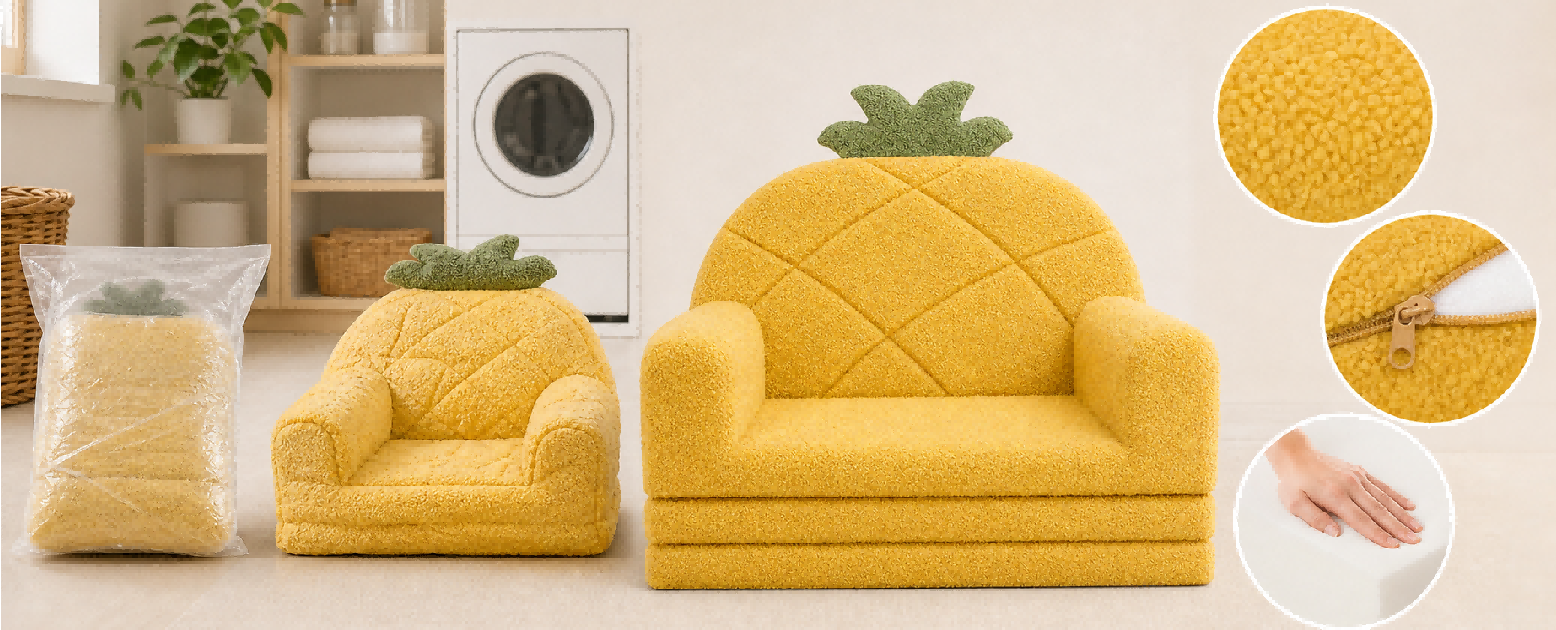
For e-commerce and cross-border retail, packaged volume directly affects freight cost and product margin. Children's sofas are high-volume, relatively low-weight products, making them suitable for vacuum compression. A well-engineered 100% foam sofa that compresses to 20-25% of its original volume can substantially reduce freight costs compared with a similar product that cannot be compressed effectively.
Reliable compression requires foam specifications that include compression set, hardness, and density; consistent cutting direction because polyurethane foam has a directional cell structure; and recovery testing on finished goods at 24h, 48h, and 72h after unboxing under realistic temperature conditions.
Recovery instructions are part of the product experience. A sofa may recover fully in 24 hours, but without clear guidance, a customer may open it immediately, see a flat or wrinkled cushion, and leave a poor review.
How Can One Sofa Become a Product Series?
Strong children's soft-furniture brands treat the first sofa as a platform.
Year one: Launch a core toddler sofa for ages 18m-4y in two or three colorways within one fabric family. Validate the foam specification, cover washability, and compression recovery in real market conditions, then collect review data.
Year two: Add a preschool or school-age version for ages 3y-6y using the same fabric, zipper system, and packaging structure. Introduce a second fabric option based on customer feedback. Develop a fold-flat nap conversion feature only if review data supports demand for multi-use functionality.
Year three: Build a coordinated system by adding modular components that connect the sofa with a play couch or ball pit in the same visual language. The brand is then competing through a children's room system, not only through one product.
This strategy requires a manufacturer that documents foam specifications, cover patterns, and zipper systems so each new SKU can build on previous development rather than restart from zero.
What Should Brands Ask a Kids Sofa Manufacturer?
What Information Is Needed to Start Development?
Tenderplay has engineered children's soft play furniture since 2013, including soft sofas, play couches, floor beds, travel beds, and soft climbing systems. We support brands, importers, and Amazon sellers in the US and Europe with OEM and ODM development.
If you are evaluating the kids' sofa category or building a product line, Tenderplay can help assess foam specifications, cover engineering, compression testing, packaging feasibility, and series-development options.
FAQ: Kids' Sofa Development for Brands and Importers
What is the minimum order quantity for a custom children's sofa?
MOQ depends on the level of customization. Standard-range changes such as fabric color selection and branding usually start lower than full structural ODM development. Project-specific details are required for an accurate MOQ.
How long does development take?
A first structural sample for a new design typically takes 3-5 weeks after the specification is finalized. A production-ready sample with a locked BOM usually requires 2-3 sample rounds.
Can a manufacturer match brand colors and textures?
Yes, for most woven and knit fabric families. Color matching requires physical lab dips confirmed against the brand reference during sampling.
How long does foam recovery take after compression?
Recovery varies by foam specification, compression ratio, storage temperature, and destination conditions. For Tenderplay's standard product configurations, the recommended full recovery time is 24-72 hours at normal room temperature, with written recovery instructions included.