
Portable soft sleep solutions are lightweight, flexible products designed for children’s travel, temporary rest and compact living environments. For children’s brands and product developers, this category offers opportunities across travel sleep products, nap mats, portable rest spaces and convertible soft furniture.
Successful development requires more than an attractive shape. Brands must balance comfort, portability, cleanability, packaging efficiency, compression recovery and market-specific product classification from the beginning.
For many families, the sleep problem starts when a child leaves the main bedroom routine. A weekend at a grandparent’s home, a hotel room, a cabin, a campsite or a small apartment can all create the same question: where can the child rest in a way that feels familiar, practical and easy for parents to manage?
That is why children’s travel sleep products should not be treated as simple portable mattresses.
In search results and buyer conversations, some teams may still use the phrase “soft travel bed,” but the final product name should follow the actual design, target age range, intended use and target-market compliance route.
For brand customers, the opportunity is to develop a small sleep-and-rest product range that considers the family scenario, product structure, carton size, cleaning requirements, compression recovery and market classification from the beginning.
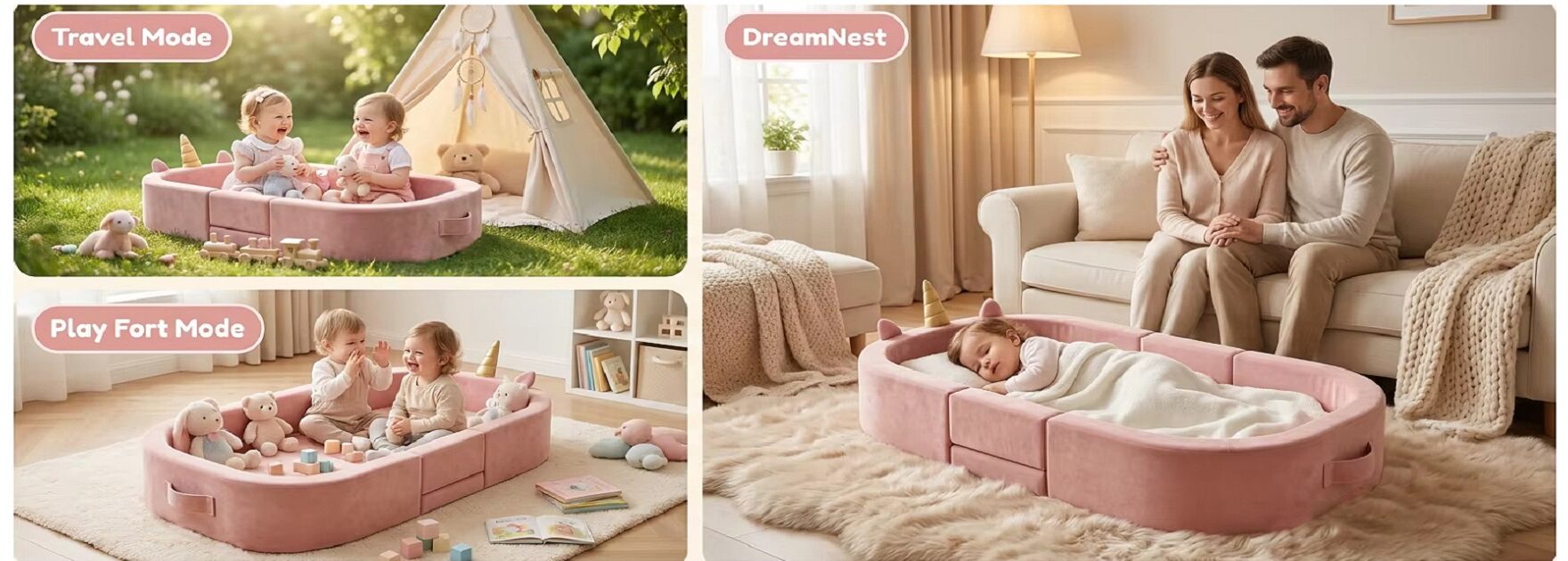
What Gaps Exist in Current Children’s Travel Sleep Products?
Traditional children’s beds are stable but fixed. Inflatable toddler products are portable but may involve pumps, noise, air loss, PVC surfaces and additional setup steps. Ordinary folding beds can be sturdy but are often too large for small homes, car trunks and ecommerce delivery.
A foam-based, low-profile structure can offer quiet setup, rounded surfaces and a more familiar, furniture-like experience than many pump-based travel products.A low-profile design may also reduce the drop height compared with elevated sleeping furniture. However, product suitability still depends on the child’s age, product structure, intended use and applicable safety requirements.
The opportunity is not to claim that one structure is always better than another. The opportunity is to solve specific family scenarios where portability alone is not enough, including:
What Are Current Buyers Looking For?
Recent buyer-facing product testing supports this direction.
According to Parents’ June 1, 2026 update to its toddler travel bed guide, the team tested more than 45 options, including inflatable mattresses, pack-and-plays and foldable formats. Its evaluation repeatedly focused on setup, disassembly, support, portability and ease of cleaning.
The same guide shows a broad visible price range among leading travel sleep products. Some inflatable options are priced below $50, while other portable formats sell for more than $100, and travel crib systems may be positioned at significantly higher prices.
This matters for children’s brands because the development route should begin with the target retail price and sales channel, not only the appearance or shape of the product.
A first-hand Road & Track family road-trip review published on July 9, 2026 also highlights a common parent trigger: a preschooler outgrows a Pack ’n Play, and the family begins looking for a sleep option that is compact, quick to set up and comfortable enough for several nights away.
For soft product brands and product developers, these buyer signals point to five important design priorities:
Why Is This a Product Category Opportunity Rather Than a Single SKU?
Tenderplay’s internal product development experience already shows how travel sleep products can move beyond a plain rectangular shape.
Sandwich-style and burger-style soft travel concepts demonstrate how shape, folding logic and color language can make a product easier to recognize and remember.
However, the product will still succeed or fail based on the fundamentals:
This is why a brand should avoid developing only one isolated travel bed or sleep product.
A stronger direction is to create a coordinated travel sleep range that may include:
A coordinated range gives brands more than a single seasonal product. It can support product bundles, replacement covers, channel-specific versions, private-label colors and future second-generation upgrades.
What Should Brands Confirm Before Sampling a Portable Sleep Product?
1. Use Case and Product Naming
Is the product a travel bed, sleep mat, rest pad, nap mat or sofa-bed?The final name should follow the product structure, age range, intended use and target-market compliance route. Naming should not be based only on marketing preference.
2. Product Size System
3. Foam Selection
Foam density, hardness, thickness, rebound and compression recovery should be reviewed together.
Density alone does not define product comfort or support. Two foams with similar density can still perform differently because of hardness, cell structure and formulation.
4. Fold-Line Position
5. Cover Construction and Cleaning
Brands should decide whether the main cover, side panels and accessories can be removed separately.Water-resistant materials can help protect the foam, but they may also affect breathability, flexibility and hand feel. Cleaning performance should therefore be evaluated together with comfort and material experience.
6. Compression Recovery
7. Compliance Route
Classification First, Claims Second
Product classification should be confirmed before names, labels and marketing claims are finalized.
In the US, a children’s product is generally a consumer product designed or intended primarily for children aged 12 or younger. Factors such as product design, packaging, labeling, advertising, intended age and consumer perception may all affect how a product is classified.
Sleep-related terminology requires particular care. Words such as “bed,” “crib,” “bassinet” or “infant sleep product” may influence the applicable compliance route, depending on the product’s structure, age range and intended use.
For the European market, manufacturers may also need to prepare risk assessments, technical documentation, product identification, instructions and relevant safety information. Products with toy-like or interactive features may require additional toy safety or chemical compliance review.
For this reason, brands should avoid broad or unsupported claims such as “absolutely safe,” “infant-safe,” “risk-free” or “suitable for every child.” Product names and claims should be supported by the final design, intended use, testing plan and target-market requirements.
Compliance requirements vary by product and market. Brands should confirm the applicable standards and testing route with qualified compliance professionals before launch.
How Can Tenderplay Support Portable Sleep Product Development?
As an OEM and ODM children’s soft product manufacturer, Tenderplay does more than provide a quotation for a soft product.
Our role is to help turn an early reference image, category idea or product concept into a manufacturable, shippable and testable product plan.
Development Note from Tenderplay
During the review of a foldable travel sleep sample, the Tenderplay team found that fold-line position, foam segmentation, cover tension and carton size needed to be evaluated together.
The next sample should not only improve in appearance. It should also open flatter, recover more consistently after compression and fit the planned packaging requirements.
This development experience highlights an important point: product appearance, structural performance and logistics should be considered together from the beginning.
Tenderplay Development Flow
1. Confirm the Product Positioning
Confirm the target age range, user scenario, target market and sales channel.The intended product category should be discussed before the structure, naming and marketing claims are finalized.
2. Define Product and Packaging Dimensions
Define the open size, folded size, storage method and target carton dimensions before creating the first sample.Packaging should not be treated as a final-stage decision.
3. Evaluate the Material Route
Review foam density, hardness, thickness, cover fabric, inner protection and compression recovery together.Material choices should support both the user experience and the intended packaging route.
4. Create the First Structural Sample
5. Test Compression and Recovery
When compression affects the customer experience, brands should prepare packaging samples, opening instructions or recovery videos.The product should be evaluated after realistic compression periods rather than only immediately after packing.
6. Review Cost and Channel Requirements
7. Freeze the Mass-Production Standard
In real development work, brands often finalize the appearance first and discuss carton size only after sampling. For compressible children’s soft products, that sequence can create avoidable redesign, inconsistent recovery and additional cost pressure.
Frequently Asked Questions
1.What Is a Portable Soft Sleep Solution for Children?
A portable soft sleep solution is a lightweight, foldable or compressible product designed for travel, temporary rest or flexible home use. Depending on its structure and intended use, it may be described as a sleep mat, nap mat, rest pad or travel bed.
2.What Should Brands Consider Before Developing This Type of Product?
Brands should confirm the target age, intended use, product dimensions, foam structure, cleaning method, packaging size, target market and compliance route. These factors should be evaluated together before sampling.
3.Can Portable Soft Sleep Products Be Customized?
Yes. Private-label brands may customize dimensions, foam, fabrics, colors, covers, logos, packaging and storage solutions, depending on the product design and manufacturing route.
4.Why Should Packaging Be Considered Early?
Packaging can affect fold-line position, foam segmentation, compression recovery, carton size and shipping cost. Confirming the packaging route early can reduce redesign and improve production efficiency.
Conclusion
Have a Custom Travel Sleep Product Idea?
Share Your Idea
Target age, market, price and reference images.
Develop the Product
Structure, materials, dimensions and customization.
Prepare for Production
Sampling, packaging and mass-production planning.
Explore our Custom Services and Production Process.