
Sourcing a kids travel bed looks simple until the first shipment arrives. Many products share the same basic format—folding foam, removable cover, carry bag—yet their long-term performance can be very different.
For brands and importers, the biggest risks usually come from specifications rather than appearance: fold geometry, foam recovery, usable sleeping dimensions, cover construction, compression packaging, and market-specific compliance.
This guide explains the questions to ask a kids travel bed manufacturer before sampling or placing an OEM/ODM order.
What Makes a Good Kids Travel Bed?
1. How Does Fold Structure Affect Travel Bed Performance?
The fold structure controls more than portability. It affects sleeping-surface flatness, packed size, visible fold lines, foam stress, and long-term durability.
Single-Fold Design
A single-fold bed is simple to manufacture and easy to explain on a product page. However, for a fixed packed length, it may limit the total sleeping length or require more aggressive compression.
Two-Fold / Three-Section Design
Two fold lines can create a longer sleeping surface while keeping the stored size manageable. Stress is also distributed across more than one fold point.The trade-off is more complex foam cutting, sewing, and quality control.
The trade-off is more complex foam cutting, sewing, and quality control.
Three-Fold / Four-Section Design
This structure can improve the length-to-packaged-size ratio, but it introduces additional fold lines into the sleeping area.
If foam hardness, density, or fold construction is poorly matched, visible ridging or slow recovery may appear after prolonged storage.
What should a buyer ask?
Request a fold diagram showing exactly where each fold line sits relative to the usable sleeping surface.
A good manufacturer should be able to explain why that fold structure was selected for the target age, packed size, and use case.
2. Which Foam Specifications Matter Most?
For a children’s travel bed, “high-density foam” is not a complete specification.
The foam must support horizontal loading during sleep, recover after folding or compression, and maintain shape after storage.
Key variables include:
Density
Density reflects foam mass per unit volume and is related to durability, but higher density alone does not guarantee better comfort or support.
IFD / Hardness
Hardness determines how much resistance the foam provides under compression.
A sleeping surface should be evaluated for the intended age and horizontal use, rather than selected only from sofa-style sitting requirements.
Compression Set
This is especially important for foldable or compressed products.
Compression set indicates how much permanent deformation remains after the foam has been held under compression.
Poor compression performance can eventually lead to one of the most common customer complaints: “The bed does not fully recover after storage.”
Recovery Conditions
Temperature, storage duration, cover tension, seam construction, and fold geometry can all influence how quickly the finished product returns to shape.
At Tenderplay, finished-product recovery can be evaluated at 24, 48, and 72 hours after decompression, rather than checking foam blocks alone.
This gives brands a more realistic view of what consumers may experience after opening the carton.
3. Which Travel Bed Dimensions Should Be on the Specification Sheet?
One “bed size” is not enough.
Brands should ask suppliers to document at least four dimension sets:
This distinction matters for both conversion and returns.
A consumer who sees only the external size may assume the entire footprint is usable sleeping space.
For international sourcing, also confirm whether the design needs to change for the target market rather than simply changing labels or packaging.
Age positioning, ergonomic expectations, dimensions, and local product classification may affect the final specification.
4. What Makes a Travel Bed Cover Truly Washable?
“Removable cover” does not automatically mean “easy to wash.”
Long-pile fabrics may create a warm, premium look, but they can also be more sensitive to pilling, matting, and moisture retention.
Tighter woven fabrics or other easy-care constructions may be more suitable when frequent washing is a priority.
How Should Brands Test the Cover?
A useful sampling test is simple:
Wash the cover several times under the intended consumer care conditions, reinstall it on the foam, and compare fit, seam tension, and appearance with the approved sample.
This can reveal practical problems that are difficult to identify from fabric swatches alone.
5. How Should Compression Packaging Be Evaluated?
Compression packaging can reduce carton volume and improve shipping efficiency, but packaging should not be treated as a separate decision from foam engineering.
The better target is the smallest practical package that still allows the finished travel bed to recover reliably and match the consumer unpacking instructions.
For B2B buyers, this also makes freight assumptions more transparent.
Compare supplier quotations using actual compressed carton dimensions rather than only the unfolded product size.
6. What Compliance Questions Should Brands Resolve Before Development?
Product classification should be defined before the final structure, labeling, and marketing language are locked.
United States
Products intended or marketed for infant sleep can fall under specific CPSC requirements.
CPSC guidance states that the U.S. infant sleep product regulation is codified at 16 CFR Part 1236 and incorporates ASTM F3118 with Commission modifications. The exact compliance pathway depends on the product design, intended age, intended use, and marketing language.
European Union
The General Product Safety Regulation (EU) 2023/988 provides the general product-safety framework for consumer products not fully covered by more specific EU product-safety legislation.
CE marking is not automatically required for every children’s product. It applies when a product falls under EU harmonisation legislation that specifically requires CE marking.
What Should Importers Confirm First?
Before mass production, confirm:
Target market → Target age → Intended use → Product classification → Testing pathway → Labeling and marketing language
These decisions are much easier to address during product development than after production samples have already been completed.
Tenderplay’s role is to support the physical product, documentation, sample development, testing coordination, and labeling implementation required by the client’s selected compliance pathway—not to replace independent regulatory advice.
7. How Can ODM Design Make a Travel Bed More Differentiated?
A travel bed does not need to remain a plain rectangular folding pad.
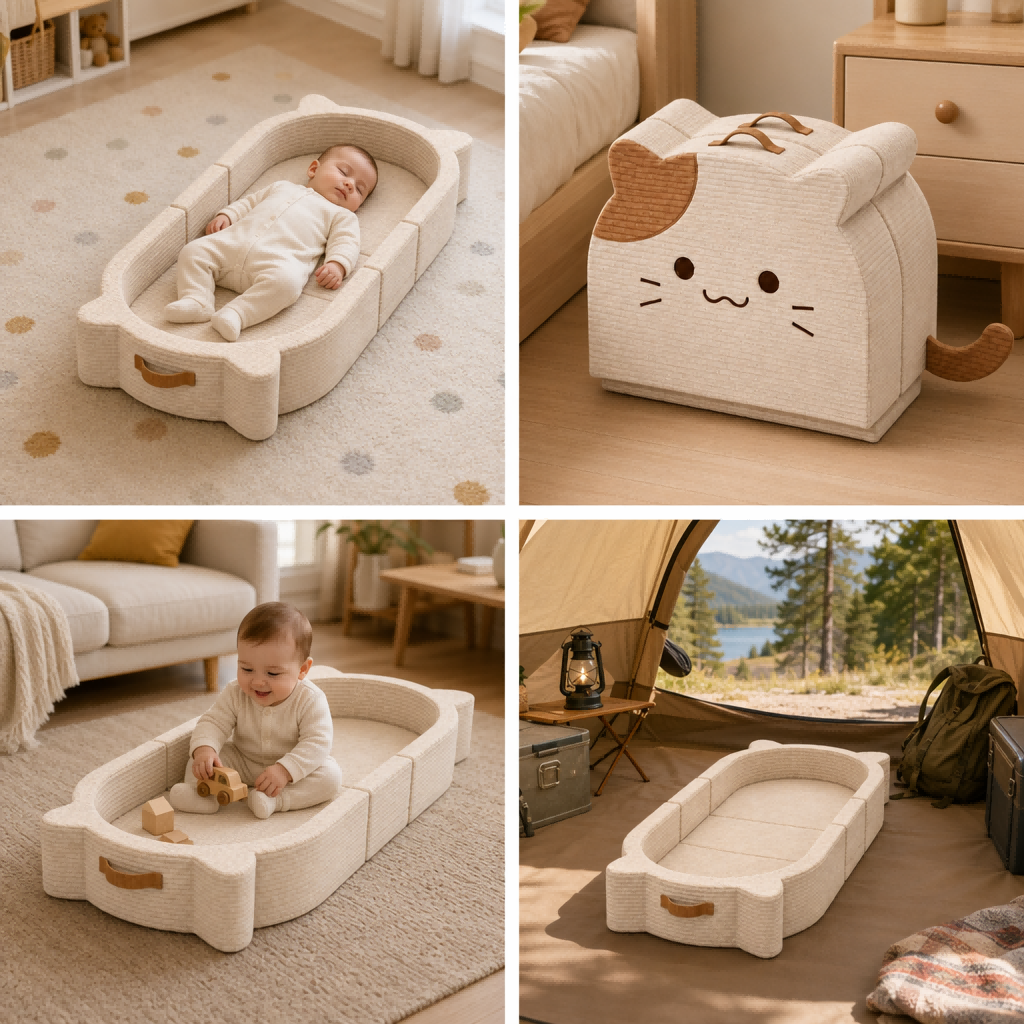
Themed structures—such as sandwich, hamburger, animal, or character-inspired concepts—can create stronger visual recognition when the styling is integrated into the structure rather than simply printed onto the fabric.
For example, the layers of a sandwich-shaped bed can correspond to the actual folding sections.
This makes the design more coherent in photography and gives the product a clearer identity for e-commerce and social content.
This is where ODM travel bed development adds value.
The objective is not only to create a different appearance, but to balance brand identity with foldability, foam performance, production efficiency, packaging, and target-market requirements.
What Information Should You Send a Kids Travel Bed Manufacturer?
A productive OEM/ODM development brief should include:
Providing these inputs early allows the manufacturer to evaluate structure, materials, packaging feasibility, and sampling direction together, rather than solving each issue separately.
FAQ: Kids Travel Bed OEM & Sourcing
Can One Travel Bed Be Sold in Both the US and EU?
Potentially, but do not assume that one specification, label set, or compliance file automatically works in both markets.Evaluate each market separately before finalizing the product.
Can a Kids Travel Bed Fit in Airline Overhead Baggage?
Some compact products may, but this should never be assumed from the word “travel.”If overhead-bag compatibility is a marketing claim, verify the final packed dimensions against the airlines and routes relevant to your customers.
What Is the Difference Between a Kids Travel Bed and a Travel Cot?
They may fall into different structural and regulatory categories depending on intended age, construction, intended use, and marketing language.Define the product positioning before selecting the compliance route.
How Long Should a Compressed Foam Travel Bed Take to Recover?
Recovery depends on foam specification, compression duration, storage temperature, fold structure, and cover tension.Tenderplay can evaluate finished-product recovery at 24, 48, and 72 hours and use the results to support product-specific unpacking instructions.
Can a Travel Bed Be Customized for an Existing Brand?
Develop a Custom Kids Travel Bed with Tenderplay
A successful kids travel bed is not defined by how small it looks when folded.
It is defined by how well the structure, foam, cover, packaging, dimensions, and target-market requirements work together.
If you are developing a new travel sleep product, send Tenderplay your target age, market, retail price, reference design, and packaging requirements.
Our OEM/ODM team can help evaluate the structure, material route, compression feasibility, sampling plan, and production requirements before you commit to a larger order.