
The play couch category exploded from a niche Montessori accessory into a mainstream nursery staple in under three years — and the sourcing landscape hasn't caught up. Search "play couch manufacturer" on any B2B platform and you'll find hundreds of workshops that stitched their first modular sofa last quarter, right next to established children's furniture manufacturers with a decade of foam engineering behind them.
Tell them apart with the wrong questions and you'll pay in returns: modules that collapse in six months, zippers that fail CPSIA, cartons that arrive bulged and rejected at Amazon warehouses. Tell them apart with the right questions and you build a category that scales.Here are the 10 criteria brands should use to qualify any OEM play couch supplier in 2026 — and the red flags that eliminate the wrong ones fast.
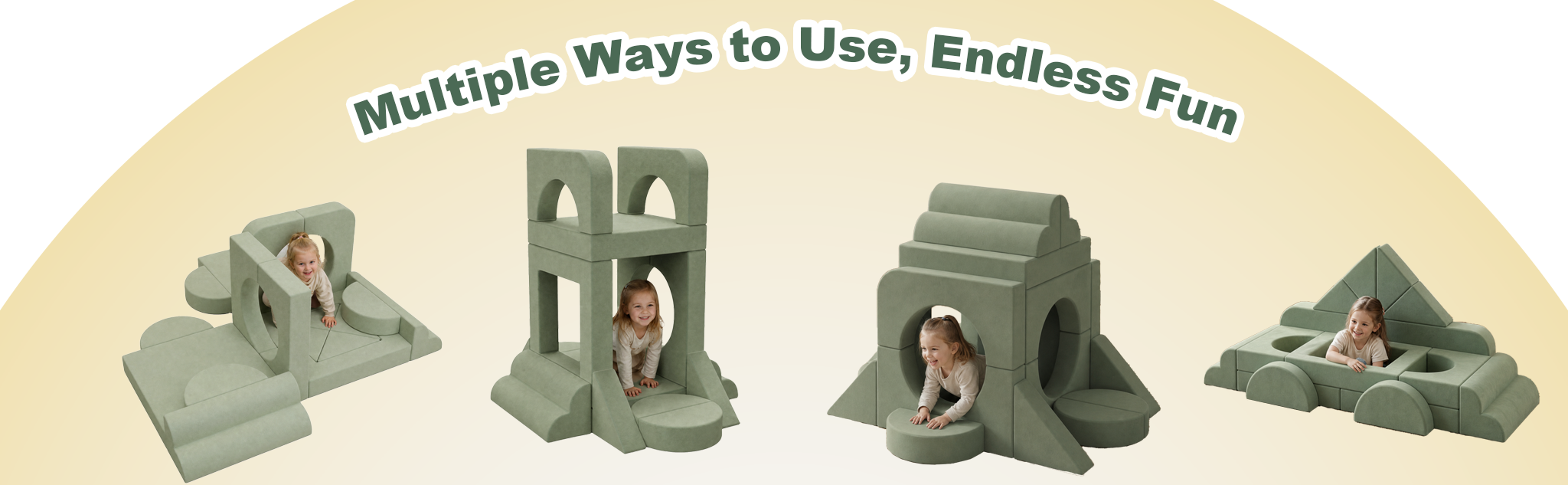
1. Category Focus: Kids' Soft Furniture Specialist, Not General Foam Shop
Ask what percentage of the factory's annual output is kids' soft furniture, and which categories they've been shipping for more than three years. A children's furniture manufacturer that has spent years engineering play couches, floor beds, and ball pits builds foam density curves, zipper placement, and edge geometry differently from a mattress factory that added play couches last year.
A specialist anticipates how a four-year-old actually uses a modular sofa — jumping from the backrest, tunneling under cushions, restacking every configuration daily. A generalist discovers those use patterns through your one-star reviews.
At Tenderplay, we've built kids' soft furniture — and only kids' soft furniture — since 2013. Every product runs through the same lens: how children use it, how parents store it, and how it holds up after years of daily reconfiguration.
2. OEM and Custom Play Couch Capability — Beyond Logo Printing
"OEM" on a supplier's homepage usually means "we'll silk-screen your logo." True OEM play couch capability means the factory can co-develop dimensions, foam zoning, cover geometry, and colorways — not just print your brand on a stock SKU.
Ask three questions: Can you modify seat depth by 3 cm without retooling? Can you propose a foam zoning plan for a 6-piece modular set? Can you develop a colorway that matches my existing product line? Vague answers mean you have a stock reseller, not a custom play couch partner.
Design depth also protects your differentiation. The brands that win aren't the ones with the cheapest quote on the same mold — they're the ones whose play couch actually looks and behaves differently on the shelf.
3. Foam Engineering: Density, Hardness, and Zoning
Foam is where 70% of a play couch's perceived quality lives — and where cost-cutting hides best. Two couches can feel identical in the showroom and behave completely differently after 90 days.
A serious compressed foam furniture supplier gives you numbers, not adjectives. Ask for density (kg/m³) and hardness (ILD) separately — density controls durability and cost, hardness controls sit-feel. Ask which grade goes into seats, backrests, armrests, and base modules; they should not all be identical.
At Tenderplay, we don't recommend "high density foam" — we recommend the right density for the right part of the product. Seats, backrests, and base modules use different grades so the finished couch supports weight where it needs to and stays soft where it should.
The verifiable standard to demand: rebound rate ≥95% and permanent compression ≤10% on finished product, measured after simulated 3–6 month use in an environmental chamber. That's a finished-product test, not a foam-block test — the two produce different numbers.
4. Certifications: The Baseline, Not the Trophy
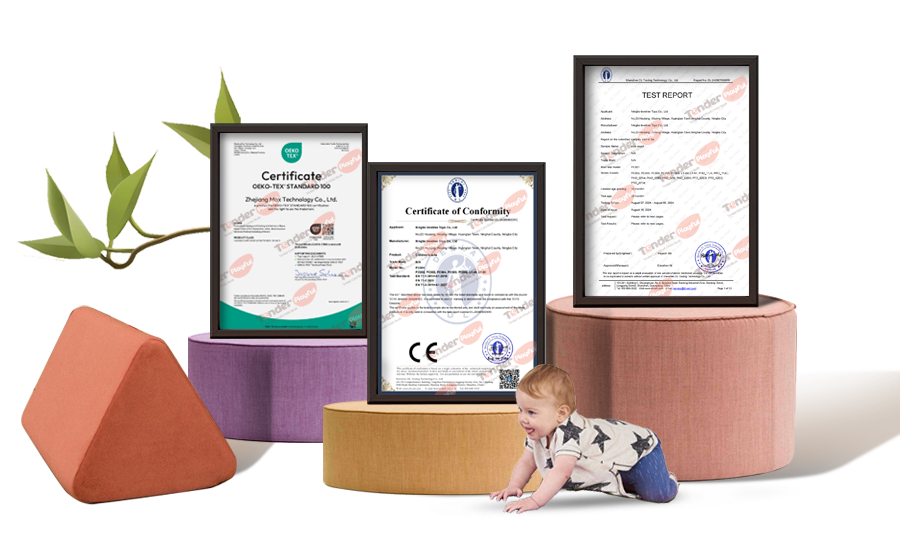
At Tenderplay, all materials are certified to EN 71-Part 3 (EU toy safety standard) and ASTM F963 (US children's product safety standard) to ensure non-toxicity — with reports available on request when you're evaluating a specific SKU or colorway.

Safety certification
All materials are certified by EN71-Part3 (EU toy safety standard) and ASTM F963 (US children's product safety standard) to ensure non-toxicity.

Environmental commitment
Using environmentally friendly fabrics certified by OEKO-TEX® Standard 100 Class I to reduce carbon footprint and support sustainable development.
5. Factory Audit: What to Verify On-Site (or by Video)
6. Quality Inspection: What Data You Should Receive
7. MOQ: Small Enough to Validate, Big Enough to Scale
The right MOQ for a wholesale kids sofa program depends on your product lifecycle. Early-stage brands validating market fit need trial quantities. Established brands scaling proven SKUs need production efficiency. A partner-grade play couch manufacturer supports both.
Ask for MOQ per SKU per colorway (not total order value), and ask what changes between a small trial run and a full production run — lead time, packaging, unit cost, and QC intensity should all shift predictably.
At Tenderplay, we support trial orders from as low as 50 units. One Amazon-seller client began with a small test batch and now moves more than 3,000 pieces per month — the sourcing model has to fit both stages of that journey.
8. Packaging: The Difference Between "Compressed" and "Compression-Engineered"
Compressed foam furniture is now a category standard, but compression done wrong creates worse problems than shipping uncompressed: bulged cartons rejected by Amazon, couches that fail to recover shape, permanent flat spots in the foam.
Compression done right requires a double-bag structure (thin inner seal + thick outer protection), a mandatory settling period to verify air-tightness, and carton dimensions measured after settling — not straight off the compression machine.
At Tenderplay,compression is a finished-product test. We seal in double bags, let the product rest for approximately two days to verify no leakage, then measure carton dimensions from the settled state — because that's the size your container actually needs, and the size your unboxing experience depends on.
9. Shipping: The Data Your Supplier Should Give You With Every Quote
For Amazon FBA sellers, add three requirements: FBA-compliant carton labeling, wrapping film that doesn't obstruct labels, and pre-shipment weight verification against system records.
10. Customization at Scale: Colors, Sizes, and Configurations
A custom play couch program lives or dies on the factory's ability to manage variation without chaos. Ten colorways sound exciting until each one has its own fabric MOQ, its own compression behavior, and its own cost curve.
A mature supplier uses a tiered color system: core colors always in production, standard colors for most OEM requests, and exploratory colors for small-batch testing. That structure lets you launch new SKUs quickly without exposing yourself to dead inventory.Ask: Which colors are always in stock? Which require MOQ per color? Which are exploratory? A factory that offers "any color you want" with no structure is either lying or setting you up for inventory pain.
At Tenderplay,color is a commercial system — three tiers of core, standard, and exploratory — so brand buyers build a SKU strategy that scales, not just pick from a mood board.
The Bottom LineChoosing a play couch manufacturer in 2026 isn't a procurement task — it's building a supply-chain foundation for a category that's still scaling. The factory you pick determines your return rate, your review scores, your FBA acceptance rate, and how fast you can launch new colorways.Use the 10 criteria above as a scorecard. Weight quality data, packaging engineering, and customization structure higher than the unit price — because the cheapest quote is almost never the cheapest landed cost.
Ready to source a play couch line with a partner who takes all 10 seriously? [Download our 2026 catalog →] | [Contact our product team →]