
Opportunity for Brands and Importers
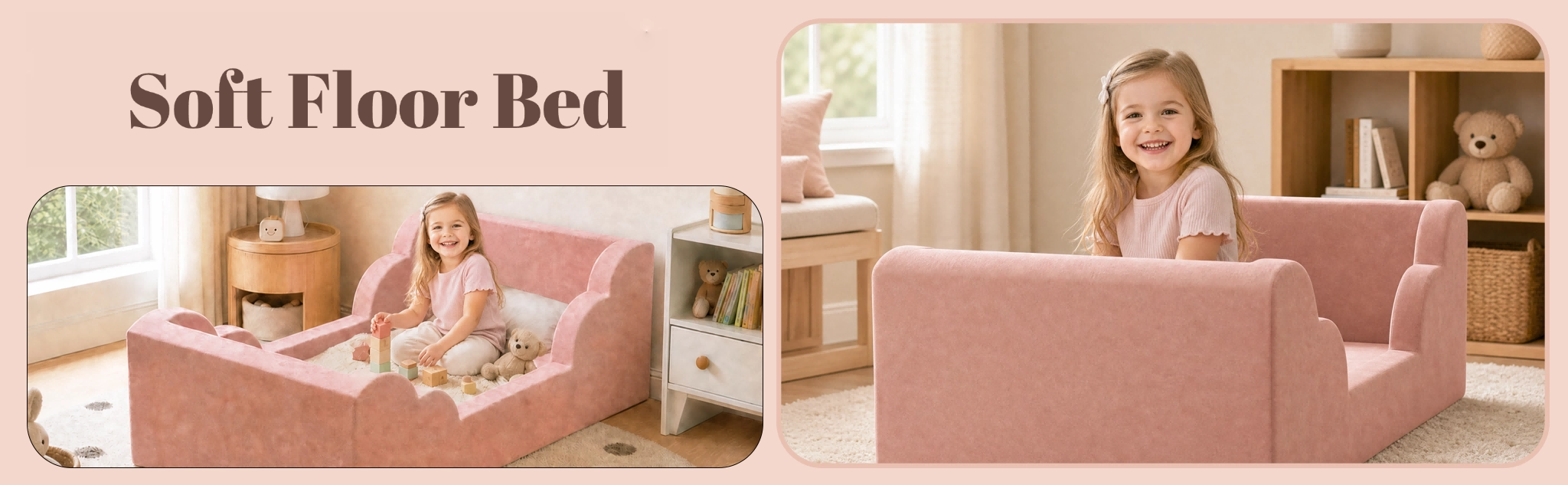
A traditional crib has a ceiling. A baby outgrows it, the parent buys a toddler bed, and the relationship ends. A Montessori floor bed is different — it grows with the child from birth to age five, which is exactly why parents are willing to pay for it and why importers should be paying attention. The products winning this category right now are all-foam, frameless designs: a soft padded base with raised plush surround rails and a sculpted headboard — think a scalloped shell or a soft cloud silhouette —with no hardwood or metal frame anywhere a child can reach. Search interest in "Montessori floor bed" has climbed steadily as the parenting philosophy moves from niche to mainstream, yet the category is still underserved compared to cribs. This article breaks down the real benefits driving demand and what it takes to source this category profitably.
The Numbers: A Category Still in Its Growth Phase
Two market signals make this category worth a serious look. First, the broader Montessori movement has shifted from specialist circles into mainstream parenting media, social platforms, and retail — driving consistent, year-over-year search growth for floor beds and Montessori furniture. Second, the crib market is saturated and price-compressed, while floor beds remain a fragmented space with few established brands and limited SKU depth on major platforms. For a brand owner or Amazon seller, that combination — rising demand plus thin competition — is the textbook definition of a sourcing blue ocean. The buyers who establish listings, reviews, and supplier relationships now will hold an advantage that latecomers may struggle to overcome.
Benefit 1: Independence and Longevity That Justify a Premium
The core Montessori principle is simple — a child sleeps at floor level and gets in and out of bed independently from infancy. No bars, no "trapped" feeling, no lifting a baby over a rail. That changes the buyer's price psychology: a crib is a commodity bought on price, while a floor bed is bought on philosophy, giving your brand room to position on values and design instead of racing to the bottom on cost.
Longevity reinforces the premium. A crib serves the first 18-24 months; a well-designed floor bed spans 0-5 years. The best designs stretch that range further with a convertible format: the plush surround rails fold flat and the base opens out into a larger sleeping surface — wide and supportive enough for a parent to lie down and co-sleep during night-feeds, illness, or the transition phase. That single feature turns a baby product into a years-long family product, and it supports a natural product line strategy — a soft mattress for newborns, a raised-rail model for toddlers, a fold-flat convertible for co-sleeping and travel— turning one philosophy into multiple SKUs and repeat purchases within the same household.
Benefit 2: Safety That Sells — When It's Engineered Correctly
The floor bed's biggest selling point is also its biggest sourcing risk. The safety benefit is real: low height (typically 5-20 cm offthe ground)removes the fall risk that comes with a raised crib. But "low and soft" is not automatically safe — and on a product an infant sleeps on unsupervised, the difference between engineered safety and assembled safety is the difference between five-star reviews and a platform safety complaint.
Three safety dimensions decide this category, and each is a place weak suppliers cut corners:
Mattress firmness must match the spine, not the showroom. A mattress that feels luxuriously soft in a sample bag may be the wrong product for an infant. Too-soft foam lets the body sink in, compromising spinal support and raising suffocation risk for the youngest age group. The correct firmness is a function of age and weight — which means the buyer must request both density and hardness figures, not accept "high-density foam" as an answer.
Edges, corners, and gaps are where a crawling baby actually goes. On a raised crib, the danger is the fall. On a floor bed, the danger lives at the perimeter: hard corners, exposed seams, and any gap wide enough to trap a limb or finger. Every corner needs to be large-radius soft-wrapped, every seam reinforced, and every opening gaps should be evaluated against the applicable safety requirements for the target market and product category.
Surround rails and zippers must survive a toddler, not just a QC table. The raised plush rails that make these beds feel safe also have to be safe: each anti-roll rail has to hold its shape and its connection under repeated pulling, leaning, and climbing. On convertible models where the rails fold flat and the base supports an adult co-sleeper, the foam and seams must pass an adult-load test appropriate to the intended use, not just a toddler-weight one — a base that holds a 15 kg child but bottoms out under a 70 kg parent will fail in the field, not in the sample room. And the cover zipper — present on every washable floor bed — may present a small-parts or ingestion risk if the pull is exposed. It belongs on the underside, behind a protective flap, tested through repeated cycles so it cannot be easily opened or detached by a child by a child.
This is where reviews live or die, and where you should demand documentation rather than assurances
At Tender, our soft floor beds follow six structural safety principles: load-tested supports (static load held ≥10 minutes with no collapse), anti-tip wide-base design, reinforced and tear-tested seams, hidden zippers placed on the underside behind a protective layer, no swallowable small parts with all gaps kept in a safe range, and age-appropriate ergonomics. Every corner is large-radius soft-wrapped — because on a floor bed, the edge is exactly where a crawling baby ends up. We don't ask buyers to take firmness on faith. We support third-party testing through SGS, Intertek, and TUV, and keep batch inspection records on file — so you can put real test data behind your safety claims instead of marketing adjectives.
Benefit 3: Shipping and Compression — The Margin Lever Only B2B Buyers See
Here is a benefit invisible to the end consumer but decisive for your P&L: the all-foam, frameless construction that contributes to a softer product structure is also what makes them ship efficiently. With no wood or metal frame, the entire product — base, surround rails,and sculpted headboard — is pure high-rebound foam that can be vacuum-compressed and rolled. A rigid crib is bulky, fragile,and expensive to freight. A compressed floor bed can drop to roughly 25% of its original volume — dramatically lowering your CBM per unit, improving container utilization, and reducing your landed cost per piece. On a large mattress-format product,that compression gap is often the single biggest variable in whether the category is profitable for you.
But compression is also where this category quietly destroys margin when it's handled badly. Three things have to be right.
The mattress must fully recover after unboxing. Compress a foam mattress too aggressively, or ship it before the foam has cured, and it arrives flat and lumpy — triggering one-star "it never inflated" reviews and return requests that erase your margin.
Our finished-product standard is rebound ≥95% and permanent compression ≤10%, measured after simulating 3-6 months of storage and transit. Compression at Tender is a finished-product test, not a foam-block test — because a foam sample that bounces back in the lab doesn't guarantee a floor bed that unboxes flat and firm in the customer's nursery
The packaging has to survive the journey and the foam's own expansion. A compressed mattress keeps pushing outward inside its bag and carton — an internal pressure ordinary boxes aren't designed for. The fix is a double-bag structure (inner sealing bag plus outer protective bag) and a carton sized to the product's settled dimensions, not the size it is the instant it leaves the compression machine.
At Tender, we use a double-bag seal, then let the compressed product rest for about two days to check for air leaks before it's boxed and released. We measure the carton after the required settling time — because that settled size is what your carton actually needs to be, and what determines how many units fit in your container.
The carton size has to be exact, or your container math is wrong. A few centimeters of error per box compounds across a full container into lost units and a landed cost that doesn't match your quote. The only protection is precise, settled-state logistics data from the factory.
We provide full logistics data with every quote: uncompressed dimensions, compressed dimensions, CBM per carton, weight per carton, and units per 20-foot and 40-foot container — so you calculate your landed cost exactly, before placing a PO, instead of discovering it at the warehouse.
Finally, the unboxing experience is part of the product. A floor bed that needs 48-72 hours to fully recover should ship with that expectation printed on the bag and in the manual — not left for a frustrated customer to guess.
For brand clients we provide recovery-instruction templates, packaging warning copy, unboxing video assets, and customer-service scripts — because clear recovery guidance is what cuts your return rate, not hiding the recovery time.
Benefit 4: Customization Depth for True Differentiation
Because the category is young, there is no dominant design template — which means real room to differentiate. The sculpted headboard is the single most powerful differentiator and your hero-image moment: a scalloped shell shape in blush pink creates a feminine, boutique look and boutique, while a soft cloud silhouette in dove grey reads gender-neutral and Scandinavian. These shapes may add little or no additional shipping volume when compressed (they compress with the rest of the foam) but completely change how a listing photographs and the price positioning it can support. Cover material is the next lever: plush teddy fleece and short-pile velvet feel soft and photograph beautifully for listings, cotton-linen reads breathable and premium, and PU leather wipes clean for daycare and high-mess households. Format (frameless mattress, raised-rail, or fold-flat convertible) targets different price points and use cases.
At Tender, we've built a soft floor bed line spanning frameless mattresses, framed soft beds, foldable models, and bedside anti-roll guard rails — and we customize cover material, color, and packaging at low MOQ. We support trial orders from as few as 50 units, so you can validate a design with real reviews before scaling.
How to Source This Category Without Getting Burned
The opportunity is real, but the category rewards careful supplier selection — and the two areas that decide success are exactly the two that are hardest to see in a sample: safety engineering and shipping. Before placing an order, ask any candidate factory for the five documents below.
At Tender, we support third-party testing and provide batch inspection records on file — the kind of documentation that lets you support compliance preparation for target channels and markets, subject to the applicable product requirements and buyer specifications.
Conclusion
The Montessori floor bed sits at a rare intersection: rising demand, thin competition, premium pricing power, and compressed-shipping economics that protect your margin. But the two benefits that decide whether you win — engineered safety and controlled compression shipping — are exactly the ones a sample can't reveal and a weak factory can't deliver. Choose the supplier on those two, while SKU depth on major platforms is still shallow, and your brand may be better positioned as the category continues to develop. Ready to source a Montessori floor bed line with a partner who treats safety and firmness as engineering problems, not marketing copy? [Request a free sample →] or [Download our 2026 catalog →] to see our full floor bed range, customization options, and MOQ details.